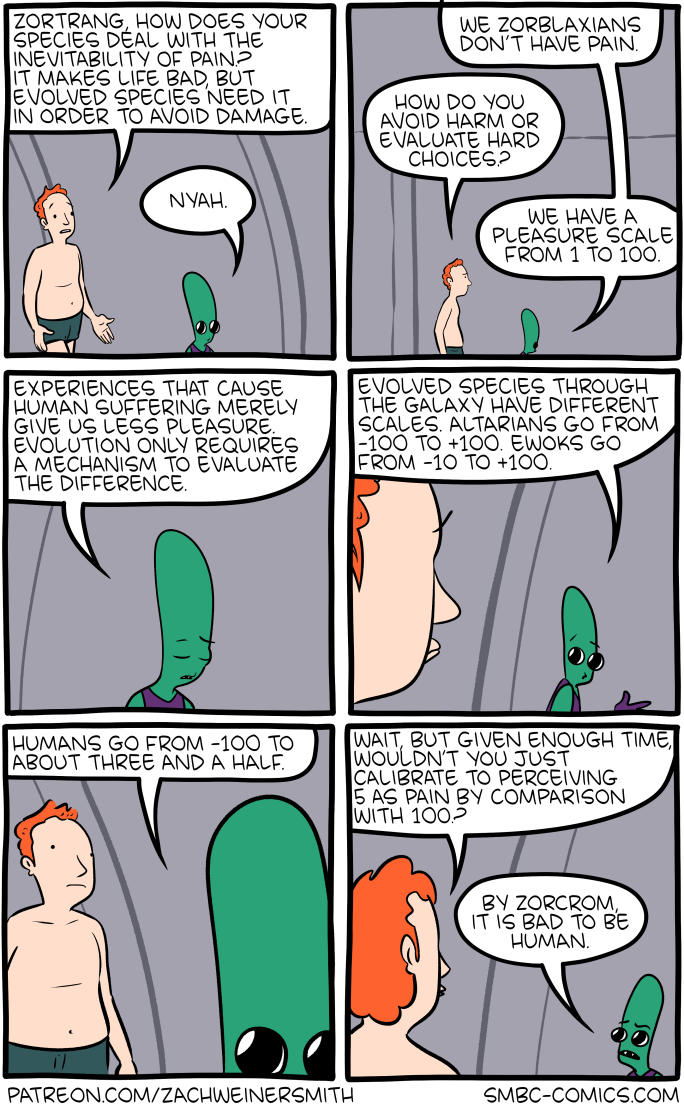
http://www.smbc-comics.com/comic/scale
Alt text
I started reading in population ethics recently and let me tell you there is undug philosophical gold.
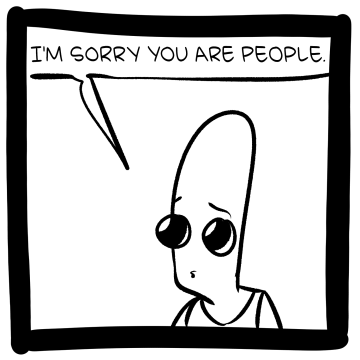
Bonus panel
You must log in or # to comment.
Nice, almost mentioned by SMBC.
It’s my theory that what we call “pleasure” (or happiness or contentment or what have you) is just the natural state of matter and that pain/discomfort is an emergent property that came about because of evolution specifically to get animals to make an effort to survive and pass on genes.
They say orgasm is a relatively “emotionless” state. Rapture and ecstasis and flow are experiences devoid of “default mode” kind of functions of the brain. The Buddhists say that “life is pain” (overly simplistic translation, but yeah) and that the ultimate goal, “nibbana” or “nirvana”, is to cease to exist. (“Nibbana” is the Pali term that you’d use for the snuffing out of a candle flame. It means something like “disappear” or “cease to be”. Not like the western concept of “heaven” at all, really.) I think it’s reasonable to argue that a lot of Maslow’s work hints at “happiness” being more of a “lack of” something (lack of “want”, maybe, which dovetails well with many Buddhist lines of thinking) than a thing in itself. Ego dissolution (the loss of a sense of self) is frequently spoken of as the most pleasant and rewarding experience that people have on psychedelics. I’ve also noticed personally that there seems to be a strong correlation between my sense of self and level of “fear”/anxiety. Fear can’t really exist without a sense of self, nor the opposite, I don’t think.
Of course, a lot of the above also indicates that you can more or less approach “pure hapiness” without ceasing to be, but then again, they also suggest that continuing to exist can only ever approximate the ideal state of happiness.
(One might think that this implies that I should be an absolute antinatalist. And I would be, except that my ontological worldview, which is a whole different conversation, implies that minimizing pain by refraining from having children is a losing game. To be fair, some of the other things I’ve said in this post are ultimately incorrect in my view when the aforementioned ontological worldview is taken into account, but again, that ontological worldview is a whole other conversation.)
One might ask why I don’t just commit suicide if that’s the best way to be. The answer is: because I still have shit that isn’t finished. I’ve got hobbies and projects to do. And, while intellectually I must admit that there’s basically zero chance that they’ll all be finished, entertaining the possibility that they may not be finished hurts my ego. (And the reason why I have a profound sense that I’ve got shit that’s left unfinished is because those of my ancestors who didn’t have that (in sufficient degree) never made (a sufficient) effort to survive or pass on their genes. As I said above, my sense of self preservation and my desire to keep being and doing things is a product of evolution.)
Ultimately that desire to keep existing, I believe, is at least in a sense pathological. If death is the ultimate form of satisfaction, then anything that I do short of that to get satisfaction is making an imperfect substitution. And what do they call it when someone substitutes something that doesn’t satisfy for the thing that actually satisfies? I can think of no better definition of the term “addiction”. (Just as one may turn to gambling or overeating or using opioids due to an unfulfilled need for love or some such.) In short, a self-preservation drive is kindof the ultimate addiction. Not an addiction I’m looking to overcome in any concrete material way (through… self-unaliving or anything like that). But an addiction none the less.
(Let me reiterate, I’m not suicidal in any reasonable sense of the term.)
I guess this is kindof existentialist thinking, isn’t it?
Whatever. Thank you for coming to my weird, spontaneous TED talk.
Aliens reading that: By Zorcrom, it is bad to be human.
(I am replying in a flip way because I absolutely see what you’re saying and it doesn’t make me any less excited about life and I believe you when you say that you’re doing the same, but I don’t want you or anyone to take this as a general endorsement for suicide)
I’ve thought about this before. Could technology in the distant future change brains so that life is way more enjoyable without substantially altering life-sustaining behaviors? The solution I imagined was similar to the one discussed here.
I don’t know if you play videogames, but if this question interests you, I strongly suggest you play Red Strings Club.