
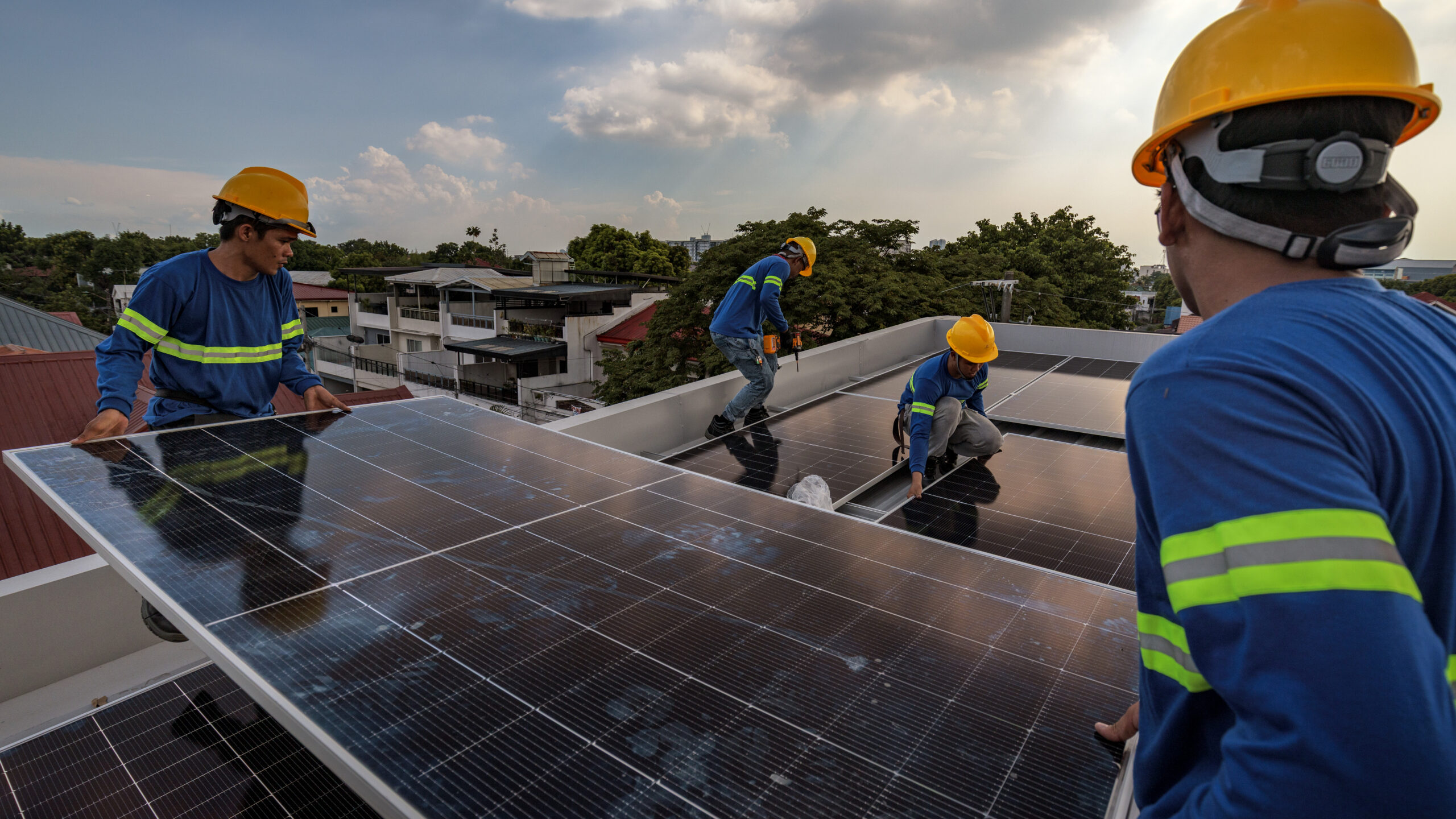
Chinese-made panels on rooftops across the world are changing the facts of life for big utilities.
This is solarpunk!
I am getting real interested in micro-scale DIY solar, both plug-in units, and the whole “stick a panel and a powerbank in the back yard and schlep it back & forth with another powerbank, manually plugging them in to power my servers” model.
I’ve been progressively downsizing my self-hosting stack, it’s now all “1-liter” PCs with 35-watt CPUs and a couple tiny ARM boxes… that’s a start, but at my budget I would probably need power banks that can automatically switch to the grid once exhausted to start powering my setup from solar. Or DIY some kind of power-switching solution on a little box that monitors the charge status of the power bank.
With your reliance on storage, I’m wondering if you have any concerns with the safety of your lithium power banks. The more I go into this the more I see that not only are not all LFP cells created equal, but substandard BMS is another possible risk. Lithium battery fires are no joke and the risk is high when these are in our living spaces.
At one time I was set on building out a large commodity 48v rack of LFP batteries for “big and cheap” storage of my excess solar power (instead of exporting to grid), but the cheap batteries are a wildly different in safety with no apparent way to know if you’re getting a good safe system or a time bomb waiting to happen.
I’ve got 10KWh of high quality Enphase LFP batteries in use now, but scaling these expensive dedicated integrated solar batteries is very expensive.
If you’ve got a shed at least 10-15 feet from the house that could be a storage solution. If it burns, it burns
For my region, that would be a decent solution, but I’m not able to build a shed for the rules where I live.
In wildfire prone areas, a burning shed might be even a larger liability not only to the residence but also hundreds or thousands of homes in the area.
I do have concerns, but right now I’m rolling the dice in a sense by sleeping and spending most of my day next to 265Wh of NMC cells and about 220Wh of LFP as “12V” drop-in replacements for lead-acid. The former is from a pretty reputable company, the latter is from a Chinese company which seems to be on the upper end of the manufacturing & testing scale, but my due diligence only went so far.
These are very small sizes compared to a whole-house system or even one that could run my servers for 24 hours, but the NMC power bank could easily start a house on fire, and the LFP units could easily fill the room with highly toxic smoke. YOLO I guess, but I’m definitely keeping an eye on battery development, and very excited for sodium-ion to become widespread.
(BTW, a big concern from LFP batteries in thermal runaway is that they can produce enough carbon monoxide to very quickly become life-threatening in enclosed areas… the risk of fire is less but the risk of being poisoned if there is an event is higher.)
These are very small sizes compared to a whole-house system or even one that could run my servers for 24 hours, but the NMC power bank could easily start a house on fire,
Can I ask if you’ve acquired a battery fire blanket or box that you could use in an emergency for your smaller packs?
and the LFP units could easily fill the room with highly toxic smoke.
This is my concern for my situation. Not only is the vapor produced highly toxic for inhalation, but also a very high concentration of hydrogen (35%-55%). I’d thought about trying to build in a ventilation system that I could engage, and then a follow-on detection system that could trigger the vent to run, but with that high a concentration of hydrogen, I’d be worried about the vent fan or relay igniting the hydrogen from a spark.
So today, I too and using the YOLO method. I’ve purchased really high quality UL 9540A Compliant LFPs, but that only goes so far.
I need to find these $0.12/W panels. Local suppliers selling Chinese panels are around $.50/W! Though the batteries and inverters are the bigger part of the cost.
https://www.amazon.com/gp/product/B0FX46V1C1
$0.365/W is the lowest I have found. You just have to buy a pallet of 31 of them at a time to get that.
Tariffs are driving US prices up, right?
That probably has some part in it, yeah. I would imagine shipping also adds to that, given the $0.12/W price is within China specifically, where they are made.
Here is an Alibaba listing for a solar panel manufacturer in China.
For me it shows a quoted price per-watt in Euros of 10 cents or less, though in this things you only really find out the real price when you get a quote from them.
Of course the reference price is probably EXW (at the factory, no shipping or taxes). Also even if they are willing to sell you 1 or 2 panels, the shipping costs will end up be a very large fraction of the total price, though in my experience once you have a big enough order from China to fill at least a part container load sent by ship (or, even better, a full container) the shipping quickly becomes a small fraction of the total cost since shipping a container over from a place like Shenzhen to Europe or the Eastcoast US is surprisingly cheap considering just how much stuff fits in one (unless you’re moving very heavy stuff, space is usually what dictates the cost).
I suppose that if you have a large enough project to be worth it, you can pay a shipping agent to do all the work (you can even find some on Alibaba) or even get the factory to at least arrange the shipping to your country (of course, for more $$$). Of course, the likes of DHL will hapilly pick it up from the factory and deliver it at your door, but by then the shipping costs are likely several times the cost of the panels themselves.
Anyways, all this to explain how big solar projects can actually get their panels at pretty close to those $0.12/watt because they have large enough amounts shipped by boat that the shippings costs per panel are very low, whilst somebody wanting to instally 10 panels on their roof won’t get anywhere close to that.
But what has been good for Shoprite, which now has around 43 MW of peak capacity at its disposal and is looking at battery storage, constitutes a problem for state power utility Eskom.
The state-owned power utility said on Monday it made profit after tax of 30.3 billion rand ($1.9 billion) in the year ended March, compared with a restated 14.0 billion rand a year earlier, which was its first annual profit in eight years.
So approximately 1,863,555,212.93 in USD. Cry me a river.
Well yes. If it was looking down, how would it see the sun?
China saving the world from global warming but the West is desperately un-saving it
can I get them offensively cheap in canada at quantities suitable for an 8-12 person home?