

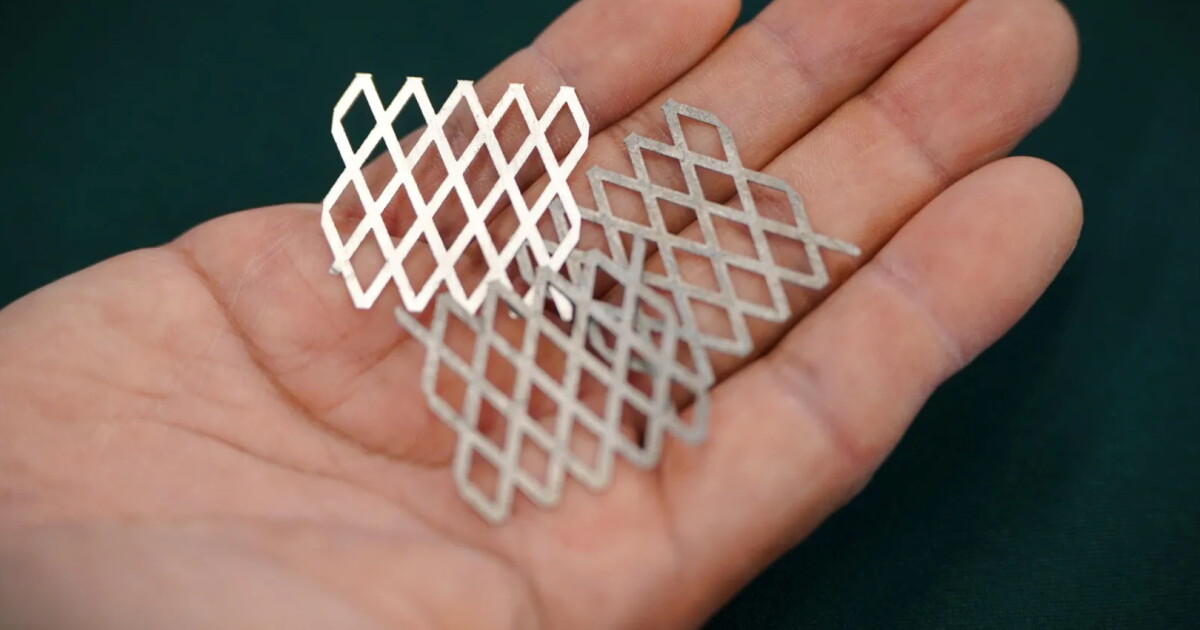
If anyone could defeat the “man of steel,” it would be a “man of stainless steel.” However, even stainless steel has its electrochemical limits. Scientists have created a version that can withstand conditions only a “man of titanium” typically does.
The interesting (to me) bit:
The experimental stainless steel for hydrogen alloy has the composition Fe-20.73Cr-20.2Co-17.7Mn-1.7Si by weight, meaning that, alongside its iron base, it contains unusually large quantities of chromium, cobalt and, crucially, manganese. The researchers cast the alloy using vacuum induction melting, forged it into a plate at 1200 °C (2192 °F), homogenized it at that temperature for 4 hours, and then quenched it in water. The result has a single face-centered cubic crystal structure, but its most important feature emerges only at high electrochemical potentials.
Like ordinary stainless steel, SS-H₂ initially relies on chromium-based passivation. However, at around 720 mV, something unexpected occurs: manganese begins to form a second protective layer over the existing chromium-rich film. As the potential rises and the conventional chromium protection approaches the conditions under which it would ordinarily deteriorate, the manganese-based layer takes over the heavy lifting.
The team calls the mechanism “sequential dual-passivation.” It’s particularly counterintuitive because manganese has traditionally been regarded as detrimental to stainless steel’s corrosion resistance. “Initially, we did not believe it because the prevailing view is that Mn impairs the corrosion resistance of stainless steel,” said study first author Dr. Kaiping Yu.