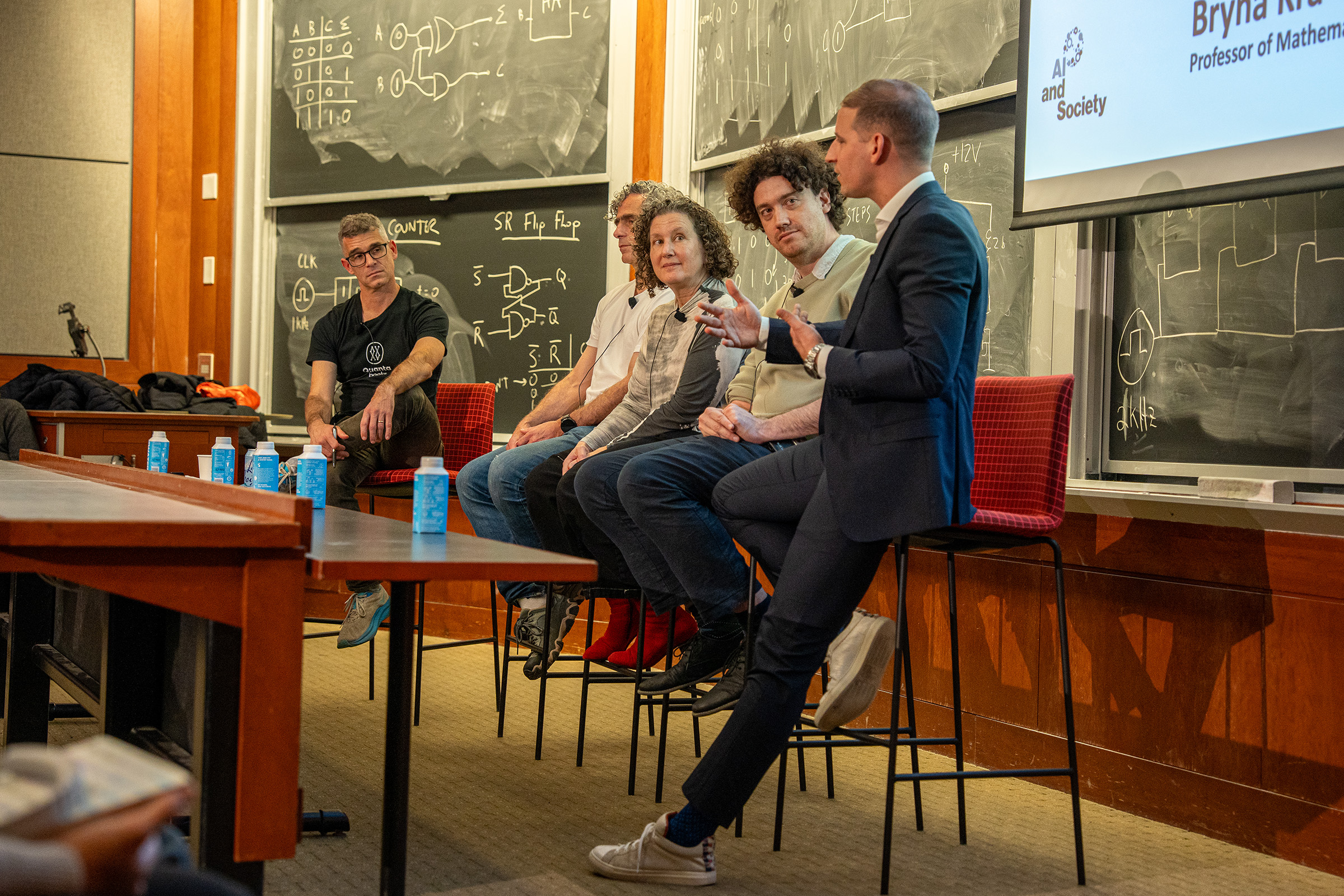
The panel must have been a good one as it does really get to the heart of it.
A mathematician is not just someone who solves problems; it’s more about the understanding such solutions generate.
That said, when teaching mathematics, the golden rule is “never give students the answer to a problem”, it demotivates them and can often demoralise. The same is true for these AI proofs; it really feels like a case of being so busy wondering if they could, they never thought about if they should.
The results of these AI “proofs”? A binary answer to a question that isn’t even a proof by Intuitionistic standards. I honestly feel that to publish something now should require a viva where you explain the contents of a paper to your reviewers over tea/coffee (at the journal’s expense of course!).
A scary prediction I have it that when the big AI companies are finished with math, they will on to all other computational research field. All papers end with an outlook that presents some problems that were outside of the scope and requires further research, i.e. “an open problem”. And every AI response paper will not.
These problems, of course, take more than a lean compiler. But at the end of the day it is just code, math and compute. And AI companies seem to have an abundance of all 3. In the scenario, they could vide code a new verifiably correct research application for each paper, and throw amounts of compute that have never been seen in basic science, just in order to keep their GPUs busy and the hype wheel rolling.
Of course, reality is much more messy than math (relevant xkcd https://xkcd.com/435/), and so this approach will probably not completely change all fields to the degree it has changed math. But all problems that can be solved by compute at scale, could be.
What value is a math proof if no human can understand it? Seems to me there is more value in a proof that is comprehensible.
A legitimate proof of the Riemann hypothesis, for example, is a goldmine for developing theory. Well, probably. I’d say it’s unlikely that such a proof contains no insights whatsoever.
There’s also value in knowing something is definitely true instead of just collectively agreeing it most likely is.
I suspect we’re gonna go back to the days of when alchemists would hide their discoveries in codes and cyphers to guard their secrets. The field of mathematics will suffer as more and more practicioners refuse to collaborate with their peers.
To what end, though? Alchemists had goals they were working towards, like turning lead into gold or immortality elixirs, so there was a reason to do their research for its own sake.
Math is a bit different with most of the bleeding edge stuff having no practical purpose that its discoverer can hope to exploit until its been known for a long time. Math benefits from a larger community in that regard because the people who solve the problems or prove new rules aren’t often the same ones that notice the link that makes it relevant elsewhere, other than maybe when they are looking at one problem hoping it will solve another.
We all have our pride. A lot of these mathematicians want their names to be associated with discovering or proving mathematical models. Besides that, you’d want a proof to be made and understood by human minds. The field of mathematics will eventually stall out on work spat out by an AI much in the same way a vibe coded software infrastructure may work okay at first but crumble whenever work needs to be edited or built upon.
worse, math with be an esoteric field, truth is what the machine says, no one can really understand it,
It already is for the vast majority of people. Differential calculus and integration are kind of the baseline for a lot of intermediate math these days and most people stopped paying attention around fractions.
point being, there’s no point in advancing maths if no human understands it.
I imagine this leads to mathematicians hiding their problems from others. Especially the chatbots.
We have been warning about this since the start.
Billionaires violating everyone’s open source licenses taught them that they are above the law. They also copied every artwork on the internet and every book and publication. The US government did nothing to stop it. This only leads to people not sharing their creations, since intellectual property theft and copyright are only a crime for the poor.
Of course when they start stealing mathematician’s work without even giving people credit, it will lead to mathematicians not sharing their work.
As long as the law doesn’t apply to billionaires, this will go on for every kind of human knowledge and work.
The credit should go the mathematicians who discovers an interesting problem and the engineers who build a calculator to help solve it. Credit should not go to the calculator.
Unfortunately we live in an age of grifting where machines are widely accepted to be “intelligent”,
deleted by creator
They say to focus on exposition, as if they really expected AI to lag behind much longer in that sector.
By the end of next year, I honestly don’t see what a human will be able to offer to mathematics that AI can’t do better.
I have always done math because I liked it. I now have a fixed position, so I can keep doing it, but I see math becoming “pay to win” (whoever has the most thorns tokens will win whichever game we decide math is) and I see no way out.
The only utility of proofs is to generate interest in the field, create a sense of community with common goals, and have something to talk about.
Abstract mathematics isn’t like science. Our goal is not to collect a bunch of useful facts. Seriously, those proofs are worthless without a mathematical community to interpret them.
So what don you propose? What should mathematicians do once AI does all the proofs and can handle exposition better than any human? I say I don’t see a way out, that I have lost hope. I’d like not to be ridiculed for it
Two possibilities, cynical and sanguine.
-
Endless poetry in a world without poets. Endless math in a world without mathematicians.
-
The invention of helicopters didn’t stop people from climbing mountains. Running a marathon is impressive, driving 26 miles is not.
I think AI slop isn’t that interesting. Seriously, unless the application is practical (which abstract math is not), I don’t care. I don’t want to read statistically generated syntax. That’s not why we do art. Did the invention of cameras stop people from painting? Did the advent of television stop people from writing and reading? Only the dumb and the lazy, who’re useless anyway.
2b. But changed the reason people crossed mountains. From necessity of various type to hobby
Agreed. I think we’ll be okay.
Universities don’t teach to pursue a hobby. A hobby is not a full time job. It’s a completely different market and context… I fear we’ll not be okay
Yes and no. People who go to university merely to “get a job” aren’t the ones discovering new math or doing amazing art. These are divergent motivations.
Maybe 40% of the student body at Harvard is doing Econ to go into consulting, but again those people aren’t the ones doing stuff whose automation would constitute a net loss for humanity.
-
How many new questions has “AI” generated? I haven’t heard of a single idea. A calculator can multiply numbers but it can’t tell you what numbers to multiply. That’s not what a calculators/“AI” does.
Sure, “AI” can brute force a path through the literature to give a yes/no answer but it’s not very valuable beyond that.
Who will be left to ask the questions once the answer are given at such a pace that we can’t keep up? A meaningful question comes from a deep understanding of the state of the art. If the panorama changes every 12 hours (VP vs VNP has been proven wrong, expectations are that P diff NP will fall soon, the theory of everything has been “proven”, just in the last day), who can ask meaningful questions anymore?
They say to focus on exposition, as if they really expected AI to lag behind much longer in that sector.
Will mathematicians want to read exposition, AI-generated or otherwise? I imagine the point of reading papers and books was to learn novel techniques which might be contained therein which they could then apply to solve other problems, but if AI is doing the proving, there seems to be little point. Mathematicians won’t feel useful reading papers, and therefore won’t feel useful writing papers without people to read them, nor feel useful directing a computer to generate papers. Why, then, prove things? Why query AI for a proof? It can’t be for the proof because there’s no point learning how it was done. To learn that a statement is true? That sounds a bit boring. It’s funny, the AI companies think they can milk profit from mathematicians or whoever grants them money to query their compute clusters. That may be short lived. I fear the entire field of math (or pure math, at least) may not exist in 50 years. Congrats to the sellouts who helped the AI companies destroy a beautiful subject. I’m sure they made a paycheck. I will never for the life of me understand why certain mathematicians have embraced AI to any extent.
Is there a chance this is a good thing? Like could math ever be completely and totally solved so we can just coast on the knowledge? If so that seems like a pretty good goal to reach.
I’m coming at this from next to zero knowledge, I promise I’m not simping for robodick or whatever here.
A lot of the high level math mathematicians are interested in is very abstract and of limited use in the real world. The tiny fraction of problems which might have solutions which could have real world applications might make package delivery .1% more efficient or rule out an encryption scheme as secure when it was already assumed to be insecure, and so on. Even the useful problems are of limited use. Then you have the vast, vast number of remaining problems which don’t have known practical applications and are merely interesting for their own sake. To be clear, solving these problems still produces knowledge, but it’s knowledge in the same way knowing about the moons of Pluto or knowing which of the exoplanets in the sky host life and what kinds of life is knowledge. That’s knowledge that won’t make batteries more efficient. It’s just nice to know.
And I don’t believe you can ever completely and totally solve math. My understanding is incomplete but there are things like Godel’s incompleteness theorems and the undecidability of the halting problem that lead me to believe there will always be unsolved problems. The problem that I think we’ll be having is computers are proving the same conjectures humans are capable of proving, and they’re doing it faster, and this is likely to leave behind the intractable problems whose proofs are out of reach for both humans and computers, and this will leave mathematicians with nothing interesting left to do.
I think it’s a fair question. Personally, I have two views in automation in general: on its own, it’s a good thing because our collective productivity increases, so we can do more with fewer resources, but in the context of our current economic system, it has as much chance of driving a genocide when the ruling class decides we aren’t worth the trouble of having around anymore.
Though there’s another angle that adds even more complexity: what will humans do when they don’t need to do anything for survival or entertainment? I suspect that point is inevitable unless we stop progressing (eventually, I don’t think it’s happening anytime soon for everything, as many tasks will require big advances in not just intelligence but robotics). But even if we figure out a way to handle the economy such that a tiny portion of people don’t get all the benefit, I’m not sure what we’ll do about the boredom if we don’t have busywork jobs like joining Star Fleet and exploring space (which at this point doesn’t even seem feasible).
How long before the immersive VR gets boring and you get tired of drinking on the beach (even with the hangover free alcohol or whatever other fun substances we stop worrying about controlling once people’s value isn’t driven by their ability to provide labour, and beaches terraformed to be all over the place so they are only crowded when you’re looking for a crowd), and have done all the interesting experiences and sports and whatnot?
Totally agree. I just understand the excitement of proving stuff that used to be unprovable, but I do think it will kill the field as we know it and I can’t imagine a new sharpie made can take after this.