
- 391 Posts
- 312 Comments


 31·2 天前
There are some interesting ideas in this essay, but I’m struck by how much it underestimates the effects of technology, and their implications on the economy.




Does it have to drop packages from 3 meters off the ground? I’d rather it landed and gently deposit them. Even so, this won’t suit all users - what if you’re not in, or in an apartment? Guess it works for people with fenced back gardens. Still, its the future of delivery. These things can get work arounds.
Researchers from the University of Cambridge made a groundbreaking discovery: regulatory T cells, a type of white blood cell, form a unified large population that travels throughout the body to locate and mend damaged tissue. This challenges the conventional belief that these cells are divided into various specialized groups confined to specific areas of the body. The implications of this finding are significant for the treatment of numerous diseases, as nearly all illnesses and injuries activate the body’s immune response.
It’s also interesting they have tested a treatment based on this insight in mice and it has worked. That said, clinical trials can take years before human treatments become available.
I’m fascinated to see how powerful open-source AI has become. The implications of its growth run counter to so many dystopian narratives for the future that imagine everything owned by corporations and people reduced to serfdom.
As robotics are essentially 3D AI, the implications hold true for this field too. Here we see more evidence of this in action. Stanford University is the 3rd major effort in as many months to announce an open-source humanoid robot. The other two are UBTech/Xiaomi, and the French grouping of HuggingFace/Pollen Robotics.
I think it is overwhelmingly more likely that future robots will be cheap, and widely available than the dystopian ‘corporations own everything’ scenario. Yet few people factor this in. Robots will be economic engines of production. What does it mean for ideas like UBI if robot ownership is decentralized and widely dispersed?

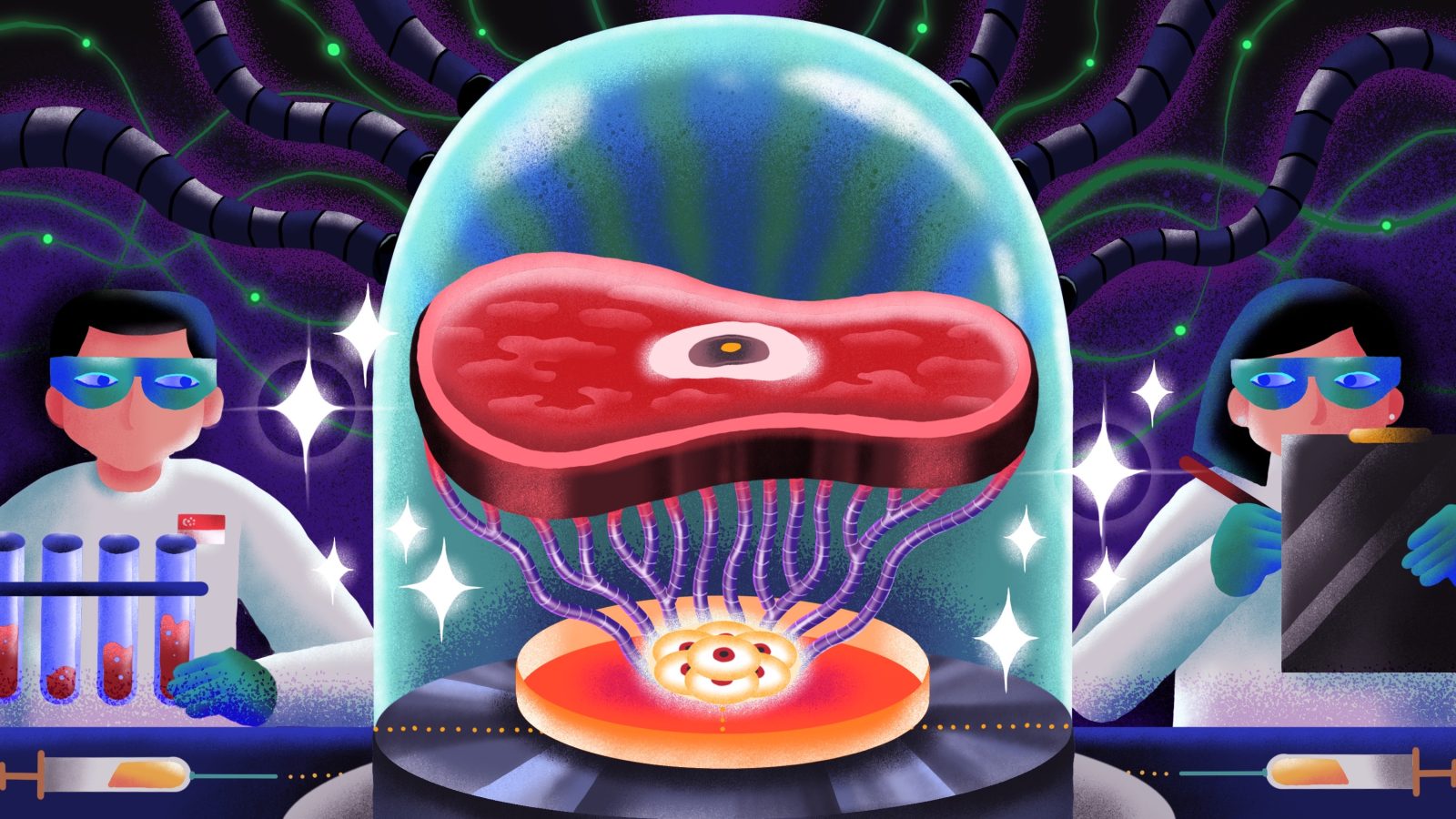
Singapore has a population of 5.6 million people and is only 12 times the size of Manhattan Island. Understandably they have little room for agriculture, particularly the land intensive agriculture that producing animals for food requires. Mostly they import that from Malaysia, which is next door.
I wonder if there are government officials in Singapore encouraging all of this with a view to food security? I often wonder the same with China and their efforts to accelerate renewables. That reduces one of their biggest vulnerabilities, that if there is ever a conflict over Taiwan that they might be militarily blockaded.


OP makes an interesting point here, that though current AI is geared to making things more efficient, it’s not necessarily as good at making them better. I agree with the general insight. Though I find his worldview a bit limited, why is it only interesting to talk about this in terms of what businesses do?


how these robots probably will be used for military purposes as well.
Yes, and not to mention what non-state actors will be able to do with this technology. I’m sure there will be a day in the future when a terrorist attack is carried out by hacked robots.
Despite all that I’m an optimist. I think reducing things like medical expertise to near zero cost will be such a huge boon to humanity, and I suspect most of this robotics power will be relatively decentralized. I don’t really believe in dystopian narratives where corporate overlords own the world and the rest of us are reduced to serfs.
In fairness the rethinkx people are doing a better job than most in drawing attention to this issue.
However, I still think the term cowardice is merited, and not just for them.
We constantly hear Silicon Valley types talk about disruption like this, but they’re always afraid to follow through with logical conclusions. I think it’s because they know the only two choices are some sort of socialism, or chaos.
It makes them frauds as well as cowards. On the one hand taking billions from private investors for AI; with the other hand creating a world where the stock market probably won’t exist, or will survive only as a shrunken relic.
the marginal cost of labor will rapidly approach zero…Moreover, history shows that although capital (in the form of facilities, machinery, and knowledge) have substituted and thus displaced labor time and time again, labor has nevertheless evolved to remain complementary to that capital.
This illustrates the problem I always have with these discussions. It’s even more frustrating in this article, as it clearly states facts, but in the most cowardly of fashions avoids honest implications. How are we supposed to have a free market economy based on capitalism when there is zero value for labor either physical or intellectual?
Every single part of our financial system is based on that; from banking to mortgages to consumer spending to the stock market having valuations to property having valuations. If every single job you can imagine, even the future ones, can be done by machines that are vastly cheaper than humans on the minimum wage, you cannot possibly have an economy that is anything like today’s. Yet cowards that they are, the authors of this article lead us all they way to that conclusion, but are too scared to say it.
There are many theories linking consciousness and quantum physics, and it’s important to say that this research doesn’t prove any of them. However, if the research can be replicated in a proper peer reviewed way, it will provide startling new correlations between observed effects of consciousness and quantum physics.
These tryptophan networks are common in microtubules, structural components widespread in all cells. Although no one knows why anesthetics cause people to lose consciousness, there is evidence for them having effects in these microtubules. There is also existing research that seems to show correlations between quantum behavior in these microtubules and the actions of anesthesia. With this fresh research, now it seems there may be a further link between these microtubules and quantum physics.
Its possible implications for AI may be huge too. Some assume current approaches to AI will lead to some form of machine consciousness; this suggests that belief may be misplaced, as 3D structures like microtubules may play a role in creating it.

Huge error? No, but sloppy,
Sure, but maybe that is a distraction from what is significant here.
Assuming this finding is valid, and can be replicated in a peer-reviewed way, then the link between quantum effects in the tryptophan networks in tubules and the action of anesthetics, is at the very least a startling coincidence.
The wonderful science YouTuber Anton Petrov has done a great video giving an overview of this finding. He discusses it primarily in the context of anesthesia and consciousness, but the discovery could have wider implications.
There are many theories linking consciousness and quantum physics, and it’s important to say that this research doesn’t prove any of them. However, if the research can be replicated in a proper peer reviewed way, it will provide startling new correlations between observed effects of consciousness and quantum physics.
Its possible implications for AI may be huge too. Some assume current approaches to AI will lead to some form of machine consciousness; this suggests that belief is misplaced.
DK has both the research and manufacturing capacity to make these claims credible. Earlier this year they outlined an improved chemistry for lithium ion batteries that might boost their capacity between 10 and 40%.
The ceramics in these batteries are too delicate for batteries that large, even so small wearable devices that need to charge much less often will be very commercially popular.
The human intestine is 6 meters long. It can be useful to locate problems with millimeter precision as this approach claims to do.
I think this is one of those ideas, that when you first hear about it you scratch your head thinking what on earth could that be useful for?, but then the more you think about it, actually these researchers have a point.
It would be silly to have large edible robots but what if the future is filled with trillions of tiny insect-sized robots? There are already drones being built this size. From that perspective, this makes more sense. For a start they are biodegradable. It gives them all sorts of uses in monitoring health and delivering medicine to animals. Suddenly you can have a whole layer of monitoring tiny robots in the environment and not have to worry about pollution when they come to the end of their useful life span. Not to mention this is a targeted way of delivering food to vulnerable species that may be affected by climate change emergencies.

I have zero confidence in the promises of any of the big tech companies when it comes to privacy and AI.
I have a feeling it will be China who gets there first with mass-produced robots. They have the manufacturing base for it, nowhere else on the planet does near as much.
What concerns me is that a lot of these efforts seem to be political in nature and are tied to mitigating the inevitable decline in the fossil fuel industry. More often it makes more sense to speed up the use of renewables and dropping the use of fossil fuels. Fossil fuel use still hasn’t peaked. That is mainly driven by China, who are still building new coal and gas electricity plants. However the peak year of fossil fuel use is very near, there is some speculation it may even be this year for oil use. From then on it will be in steady decline, so of course that industry is going to do everything they can to delay.
This is interesting as it runs counter to what many people think about current AI. Its performance seems directly linked to the quality of the training data it has. Here the opposite is happening; it has poor training data and still outperforms humans. It’s not surprising the humans would do badly in this situation too; it’s hard to keep up to date on things that you may only encounter once or twice in your entire career. It’s interesting to extrapolate from this observation as it applies to many other fields.
One of the authors of the paper goes into more detail on Twitter.
It’s important to note that the only people arguing that solar energy and food production are incompatible are involved in disinformation campaigns against renewable energy. I see it being used a lot in talking points to muddy issues.