
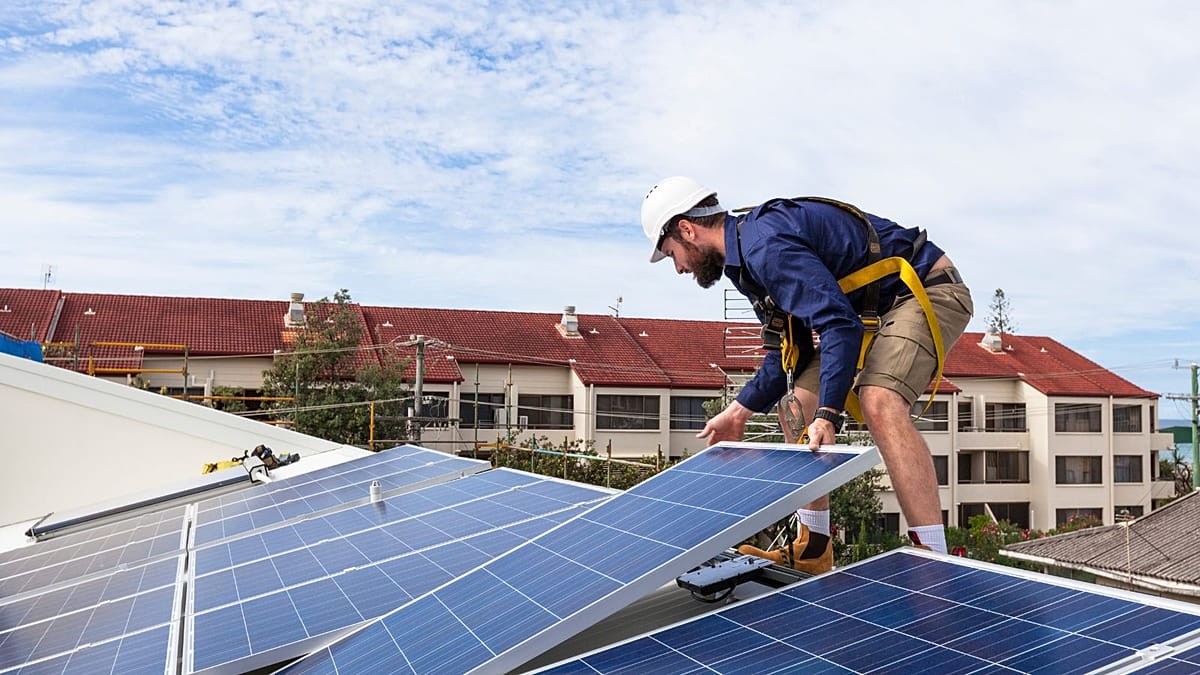
Installing solar panels on your home or business is common in many European countries. But they really come into their own during energy crises.
“If you’ve got a solar roof on your home and you’ve got a battery then, depending on how much energy you can generate, you are substantially insulated from importing electricity,” explains Matthew Clayton, CEO of UK-based Thrive Renewables.
Dynamic tariffs are becoming more common in Europe. This is where the price of electricity varies throughout the day and night, with costs going up during peak periods, like dinner time, when households are using more.
This means that if you store up solar power during daylight hours, when the sun is at its strongest, then you can use that energy, rather than drawing it from the electricity grid, during the most expensive periods. “Your relationship with the grid is totally changed,” says Clayton.
It’s possible, but needs to be engineered for safety, and that design/testing/certification will increase the cost and complexity.
You can have solar panels and a battery totally off grid, where the big battery just acts as a generator, with its own inverter creating AC power for anything you plug in. That’s really simple and cheap, but isn’t safe for connecting to and powering a grid-connected house circuit. So anything you want to power with one of these systems needs to be plugged into outlets that only get their power from these batteries.
You can add a grid-following inverter that safely matches the grid frequency AC, so that you can use the solar power you collect in your own normal home circuit, to power your own household appliances. But the simplest design here is a grid following inverter that doesn’t work when the grid isn’t connected. It can only add to something that already exists and can’t do things on its own.
If you want to do both, where it can work without grid power and it follows the grid when the grid power is on, you’ll have to design a system that can switch between the two modes without delivering power where it’s not expected or generating power that conflicts with the grid’s AC waveform. Making it automated, like an UPS system, is even more complicated.
It’s not impossible, or even that difficult, it just does add complexity and the engineering tradeoff is always the question of “what problem does this solve, and is solving that problem important enough to devote these resources to it?” For anyone on a reliable electric grid where power outages are rare, the answer is usually no.