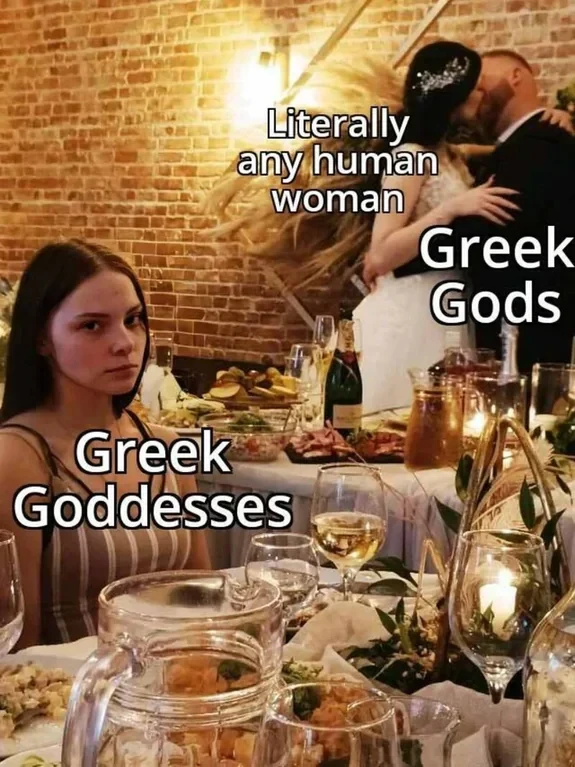

Explanation: In Greek mythology, the gods have a concerning tendency to carry on affairs with (or rape - ancient mythology is gruesome) mortal women. Despite almost all of said gods being already married to deities.
Your wife is literally goddess-tier, what are you doing guy
One important nuance is that Greek deities tended to be “human, except more”. More powerful, but also more prone to negative traits. Their gods tended to be dicks, but their goddesses also tended to be cunts.
Like, in what’s probably the most famous mythical epic, you have the deification of envy sparking a fight over who’s the most beautiful, which ends with the three most powerful of them agreeing on a judge, then all three trying to bribe that judge. Nevermind that Aphrodite fulfills her promise through adultery that sparks a war, which even the gods end up participating in over various shades of wounded pride.
I’m also inclined to think that Aphrodite wasn’t the only one cheating on her husband left, right and sometimes right in front of him. It sure doesn’t seem like the other gods took issue with her inciting adultery, specifically, rather than the general “how dare you win this contest by being a better cheater”.
So with those jealous, petty and probably also unfaithful goddesses for wives, I’m not sure “god-tier” is a convincing argument.
Doesn’t make the rape (if not explicit, then due to the extreme imbalance of power – you’re not gonna say “no” to a guy that can and quite possibly will ruin your entire harvest) any less despicable, of course.
No matter how hot a person is, someone somewhere is sick of their shit.
Lonely Rosepilled and Blueprintmaxxed
Were Greek relationships status quo monogamous?
Not exactly. There was a custom in some parts of Ancient Greece where young male apprentices (teenagers) had sexual relationships with their (adult, married) teachers during the time they were apprenticing.
Their relation to sexuality is difficult to compare to our modern one. As I understand it, once they reached “full” adulthood, men were expected to settle down, form a family and all that. I’m not aware of polygamy in the sense of formally having multiple wives at once being a thing (but I’m nowhere near an expert, so I might be colossally wrong).
Obviously, the (male, wealthy) elites that write to us may not be entirely forthcoming about the goings-on within the households. Given that slaves were at the absolute mercy of their owning household’s master, I’m inclined to think that the depictions of their gods as lustful and unfaithful are a projection of their own vices and habits.
What I do know is that Sparta in particular is reported to occasionally have Spartiates “lend” their wives to other Spartiates (but I have no idea how often it would have happened). We’re not going to talk about the women’s consent here… If the Spartans’ practice of sharing their wives was noteworthy, that implies women were otherwise expected to be chaste and faithful.
But men? Like I said, what they did to their slaves wasn’t anybody else’s business.
For the women, yes.
For the men, generally not.
And geese. Zeus liked to cavort with geese.
Also, the human women generally weren’t all that into it.
Obviously the answer is because it had to happen for narrative and plot reasons, but if we wanted to try to rationalize it maybe it’s the same as having a furry fetish: lower lifeforms with traits that would be considered repulsive, but it’s kinky and exciting to some.
Thank you for this rationalization of the furry fetish. Now I can fully accept it and the people who have it.
I’m glad I could help greek gods find a way to relate to it. May you not deign to notice me further.
Yes, please?
You know Hera was taking side dick on the regs, but had enough sense to not do it while ovulating
That reminds me of a story of the Roman Emperor Augustus’s daughter, Julia!
She was infamously… unchaste, shall we say? But in Roman society, a common compliment of marital fidelity was that your wife’s kids look like you. And all of Julia’s kids looked like her husband.
When asked how she accomplished this despite her ‘reputation’, she supposedly responded, “I never take on a passenger unless the ship is full.”
Human? Bro I got news for you…
Dat ass has a different meaning for Zeus.
‘Goddess’ is a hereditary title, and does not guarantee she looks like a goddess.
I’ve seen Ancient Greek statues of their goddesses, mfing Greek gods just had no taste
Sculpting an unflattering portrayal of one of your petty, capricious deities seems unwise.
The Greek gods were generally, in some way, portrayed as “amplified” versions of humans, and not strictly in a good way. More powerful, but also more jealous, petty, greedy. That extends to their appearance as well.
Consider how most of the men were sculpted as toned, muscular, all the markers of a man that has the leisure for exercise and sports rather than working the fields. However, Hephaistos was described as extremely ugly, which implied they didn’t fear his retribution for presenting him like that.
Consider further that the majority of the goddesses’ portrayals will have been made by men. It’s hardly surprising that they’d project their preference for attractive women on them. Exaggerate that, and you end up with a bunch of really hot goddesses.
I don’t think they were strictly concerned with flattering the gods. They were just men in a patriarchal society where treating women as objects of desire was normal.
Eh.
It might be less wise to sculpt something that was …unsubtle.