

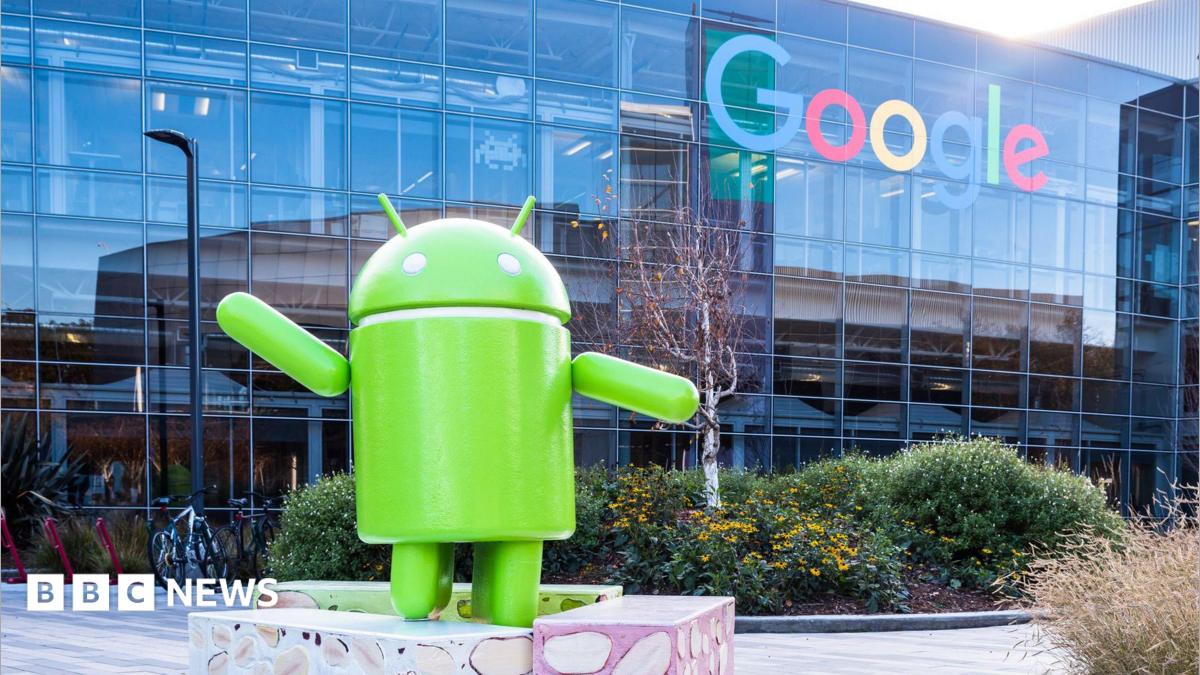
significant investment to ensure Android remains open.
Unless you want to install apps not from the google app store. Or develop apps not for the google app store. Or use a Captcha without having google services. Or use your bank website without google services. or use the internet without chrome. or… shit, sorry, I don’t have time to list all the ways google wants the exact opposite of anything anywhere remaining “open” unless by “open” they mean “open to google’s exploitation”.
Using the internet without Chrome is basically the only thing you CAN do on Android out of this list.
…for now.
And google definitely doesn’t like that. lol
Now lets use part of that money, to fund the development of open alternatives and interoperable protocols / standards. We cannot break a duopoly, if there aren’t any alternatives, otherwise it will keep being a duopoly.

4 billion can go a very long way.
Believe it or not, straight to data centers
Datacenters are not inherently bad…
They aren’t inherently bad, but they are bad when not used it built in the public interest on a planet with runaway greenhouse gas emissions and collapsing ecology.
If someone ever brings up one of those data centers, we can talk about their good aspects. There definitely are plenty, but I don’t think the poster was talking about those.
So what you’re saying is… they’re inherently bad.
Need another one now for all the removal of side loading, that is another big antitrust issue. Best make the fine actually worth something this time.
about 0.11% of Google (Alphabet)'s total worth.
I was going to say “Finally, a fine with some substance!” but you took the wind out of my sails…
Total Worth doesn’t matter. What matters is revenue and profit and that is the basis for the fine.
You might be technically correct, but these fines don’t work, have never worked, and are nothing more than money changing hands for a moment before the government gives those companies grants and shit anyways.
You will never change anything with these performative fines…that’s all they are. People see big numbers and think omg the government is doing their job!
3 months later the government gives the company a fucking contract worth double the fine anyway.
The system is broken and I’m tired of pretending otherwise.
When it comes to something punitive like a fine, fine versus worth is literally the only thing that matters. If the fine isn’t big enough, it’s more like a fee for doing business. They just added to the bottom line and keep rolling.
I think worth and cash flow are too loosely correlated for that to work how youre intending. I’m all for punitive fines for corporate malfeasance, but if they’re based on worth only, a company could easily become insolvent even from fines that aren’t intended to be fatal to them.
If it is based off their cash flow instead and potentially distributed over a period of time, it can do multiple good things at once: force the company to literally pay for the harms it caused, damage their operations enough to financially discourage the behavior, and keep corporate behavior in line through examples without frequently disrupting markets by unduly bankrupting companies.
If a company does end up doing something so bad that it is unforgivable and irreparable, and it’s deemed worthy of destroying them or punishing those responsible directly, I can see the reasoning for that, too. But, I think it would work best if the punishments are dialed in to have the desired result as often as possible. Allowing the possibility of offenders correcting course seems better for everyone while still allowing any victims to get justice.
The question is how much money did they make by using Android to block rivals. If using Android helped them make 1bn extra then this fine costs them 3bn and it doesn’t make sense from them to keep doing it. If they made 100bn than obviously they will continue.
I mean, with it they’ve managed to build a walled garden that includes the majority of every phone in the world.
We can probably assume trillions.
It’s all hypothetical. You can’t know if any of the rivals had any chance at gaining significant share of the market. I was using Blackberry when it was still perfectly fine OS, supported by all the important apps (but before everything was an app) and I didn’t know anyone else using it. I think that yes, the deals they made stopped most of the phone manufactures from offering alternative OSes like Geko OS or Lineage OS (before it was called like that) but we can only guess if any of them had any chance of becoming anything else than niche curiosity like Graphene OS today. So you can only really compare this fine with what they are doing now to block Graphene or AOSP. I don’t know if this fine is big enough but I doubt they made trillions thanks to those practices.
the price of doing business
Google’s behavior in this debacle has been utterly shameful. They got caught with their dick in the pie and have spent 8 fucking years arguing that it was for the good of society.
While continuing to thrust harder.
have spent 8 fucking years arguing
Part of the plan.
The fine is not the largest ever imposed on Google, however.
In October 2024 a charge was brought against the firm by a Russian court for restricting Russian state media channels on YouTube.
The fine was for two undecillion roubles - more than the world’s total GDP.

👍🏽great stuff. BTW, stop using google products, there are enough good alternatives.
Is there a good alternative for maps?
It depends on what you use Google Maps for. For straight-up navigation, CoMaps is good. And I mean it’s good at the navigation itself for the most part. Although sometimes when you enter in an address it thinks you’re referring to the entire street. But most of my favorite restaurants and a lot of locations that have been open for a while aren’t on it, which I’ve been happy to add. Locations that have been closed for a while are still on it, which I’ve been happy to delete.
But if you use Google Maps for discovering places or looking at pictures or seeing reviews of businesses, or if you do a lot of multi-stop trips, comaps doesn’t have those features even in the littlest, tiniest bit, and in that sense there is legitimately no (Foss) competitor. For instance, if you’re out and about on a vacation and you’re trying to find a restaurant, nope, comaps is useless for that. If you’re trying to plan a trip by seeing what’s around somewhere, nope, useless for that too.
It really just focuses on navigation itself, and it does a pretty good job of that. I use it to get around when I drive.
I really want CoMaps to be a valid choice. Its maps look are absolutely great, like Ordnance Survey Maps. But I don’t normally use it for the reason I experienced again just today. I use Android Auto in the car with my GrapheneOS phone, but my phone SIM reader failed the other day, so this phone has no internet. Google Maps refused to work without internet. So I just used CoMaps again today. This is in the UK, and lack of traffic info matters. It does routes down the little country roads that are technically 60mph, but you literally can not drive that fast down them. Even with a death wish. But it plans them in assuming that speed. This results in bad routes and inaccurate times. (Though I do enjoy country roads, when used well.)
On the plus side, it worked without internet!
So you’re saying that you can’t drive this speed limit on those roads because of the amount of traffic, right? not because of some sort of geographic feature or shape of the roads?
Yeah…hard to imagine much of a way to get traffic updates in comaps, or any OSM project honestly. It seems like it would have to be a separately maintained service. And either way, I’m guessing the number of users that would buy into something like that just wouldn’t be enough to get meaningful data most of the time. Especially since it pretty much relies on tracking people’s locations, which I feel like is counter to the purpose of most people’s reason for getting into those services.
I think they do mean that the layout of the road means you can’t drive at the speed limit. In the UK we have quite a lot of rural roads that are technically legally 60mph limit roads, but they are in reality very narrow, windy roads that you couldn’t safely drive on at 60mph. I guess CoMaps goes by speed limit for estimates so it measures these roads as if they are 60mph but in reality you may only be able to go 20mph without dying
CoMaps fulfills most of my needs
HERE WeGo (aka HERE Maps) is not FOSS, but has traffic, satellite view, offline mode, etc. Some POI might be outdated (due to it being not Google)
No, everything I have tried is worse in significant ways. Let me know if you find a genuine alternative.
Comaps is actually not bad. It’s limited in info to what’s on OSM, but good news is you can help by updating the spots you frequent!
Doesn’t have satellite view or bus/tram navigation
It also plans routes longer than Google maps, and 90% of the places you want to go don’t come up in search.
Yes.
I have only one of their services that I do not see replaced any time soon. YouTube. What they do there is impressive, and very, very hard to replicate.
Not a fan of YouTube, don’t get me wrong. But I see nothing comparable out there (maybe AWS, but they just run some infrastructure orchestration).
Google will kill YouTube long before anybody else is able to pull off the same stunt.
Or is there a service comparable for video streaming?
Nebula.tv is great, but won’t replace all of YouTube.
Been using Newpipe/Pipepipe for the longest time, but Google has been screwing with the Youtube API so the Newpipe Extractor hasn’t been working properly for the last two updates. Can’t keep a video playing in the background for long, can’t download OPUS audio files, playlist albums from YouTube Music are still iffy.
Genuinely about to switch to Nebula or Peertube. Fuck Google, I hope Pichai dies.
Those are just YouTube clients, though. The 1st-party YouTube client apps are pretty widely regarded as crappy, but they are far from the main problem. The YouTube content and its distribution are almost totally unmatched and almost certainly operate at a loss. Google is uniquely willing and able to operate it that way because it adds more value to their other business units than it costs them.
Such as iOS?
Lineage OS and Graphene OS.
Both of those are soft forks of Android, meaning they still exist at the whim of Google.
The only real alternatives are Sailfish (proprietary userland, relies on Halium for its devices to run, which means the devices have a limited lifespan as they rely on a specific version of the Linux kernel that will eventually stop being supported), UBPorts, Droidian, etc. (also relies on Halium, but the userland is open sourcs), and mainline Linux distros like PostmarketOS (has one device that is fully functional, but is extremely slow, but device support is slowly improving over time).
All of those alternatives also support an Android compatibility layer, presuming you don’t rely on device attestation DRM like Play Integrity.
If I can’t have hardware that supports open source Android forks, then it means that I won’t buy it. I can work around with dumbphones, MiFi routers with tethered Linux or BSD portables. I will not use a proprietary system outside of work, full stop.
If i remember correctly, GNU is working on a Librephone, the progress is slow tho
If you can. The problem there is Play Integrity API, which is used as an anti-competition measure.
Revolut was the only app I had issues with on Graphene OS. I obviously closed Revolut account and continue using Graphene.
I use Revolut with no issue on GrapheneOS. Maybe things changed.
Sure, but I’m not interested in that ecosystem at all. My desktop and my tablet don’t run proprietary software. My phone runs a few apps which rely on sandboxed Play, but honestly, I don’t need them badly so I could stop tomorrow.
Yeah don’t use android. Use android. And android but only for google’s phones. That’ll learn 'em.
Google makes a good, open, affordable phone with 7 years of support. They suck but their phone is not the problem here.
Use whatever nonproprietary open/libre systems that are out there. Right now, for mobile smartdevices that’s Lineage OS and Graphene OS. If you want GOS, that’s currently limited to Pixels. I’m not giving a shit about proprietary vendors, it’s a freedom thing. If I can buy open hardware, I will.
I think my next phone will be Graphene. I’m sick of iOS bullshit
What issues does iOS give you? I was a first-gen Android adopter and loved it, had the Dream (first Android phone that came out) right away, then had another Android phone after.
When phones went away from physical keyboards, I tried my partner’s iPhone and typing on a screen was much better then on Android phones at the time, so I picked one up. Lasted five years, and during that time, I dropped all Google products and services.
I haven’t run into any issues myself, and I find I can keep them for a long time without having to upgrade. I don’t tinker on my phone, though—I work on my full computers and other stuff, but I just want my phone to do internet things quickly, take sick pictures of cats, play music, and shitpost.
Pay who?
European Commission of course. They are the only ones left in the world trying to rein in the tech giants.
in the ideal world they would use the money and give it to open source phone projects.
I’d go further, I think in an ideal world all the countries of the world would be funding these projects and holding these huge tech companies to task.
Snack money.