Ancient fediverse📌
So sad these beasties went extinct… 10,000 years sounds like a long time but geologically speaking we only just missed them.
Sad? Not sure I’d want to live in the same time period as them
Why not? Because they’re dangerous? Obviously there is some uncertainty with extinct animals but I don’t think they’d be any more dangerous than elephants which still exist today.
Probably because of their predators also existing at that time.
Resurrecting them and mammoths may help fight global warming. So maybe it’s more dangerous not to have them.
I think this is somewhat speculative but there’s only one way to find out…
Unfortunately I think despite the hype from some startups de-extinction is an incredibly hard problem that will not be solved any time soon.
Something about them stomping on lichen to allow grass to grow in the Arctic.
Yadda yadda… Good enough for me!
I’m actually quite curious if mega-herbivores would help reduce fire risk on a warming planet. If can be done with mechanical thinning or controlled burns but I don’t see how we get the money and manpower to do this over the massive forested areas of western North America.
But if there was an animal that ate and/or destroyed smaller trees and brush while leaving larger ones, they could reduce fuel loads for free. We know elephants do this in Africa so perhaps mastodons and mammoths did the same thing in the ancient American ecosystem.
I don’t know about that, just that grass over lichen in tundras is better.
Folks probably wouldn’t love them coming down further South.
We didn’t miss them we ate them.
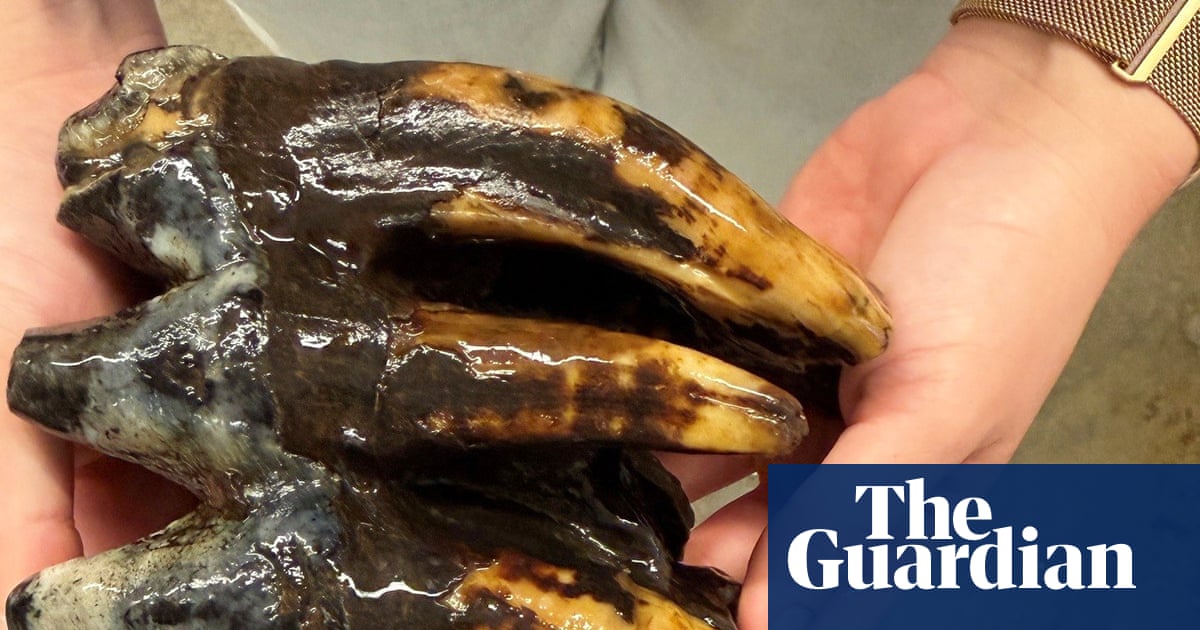
Wow. Imagine having to pull one of those things out.
Would a 10,000 year old tooth even be considered a fossil?
One technical definition defines fossils as remains “‘not demonstrably postdating the beginning of the Holocene” (i.e., older than 11,700 years).
If the tooth are fossilized, they are fossils. So when the tooth tissue is replaced by minerals.
Mineralization is a slow process, and the photo in the article could pass for a fresh tooth—which is why I looked to see if there were more precise definitions.
Banana for scale?
Very cool!
Also, unless the image is not from this finding, the word should be teeth. There’s clearly more than one
It is a molar. One tooth.
Thanks for the clarification ✌️
I read the article, but somehow missed that part 😊
deleted by creator