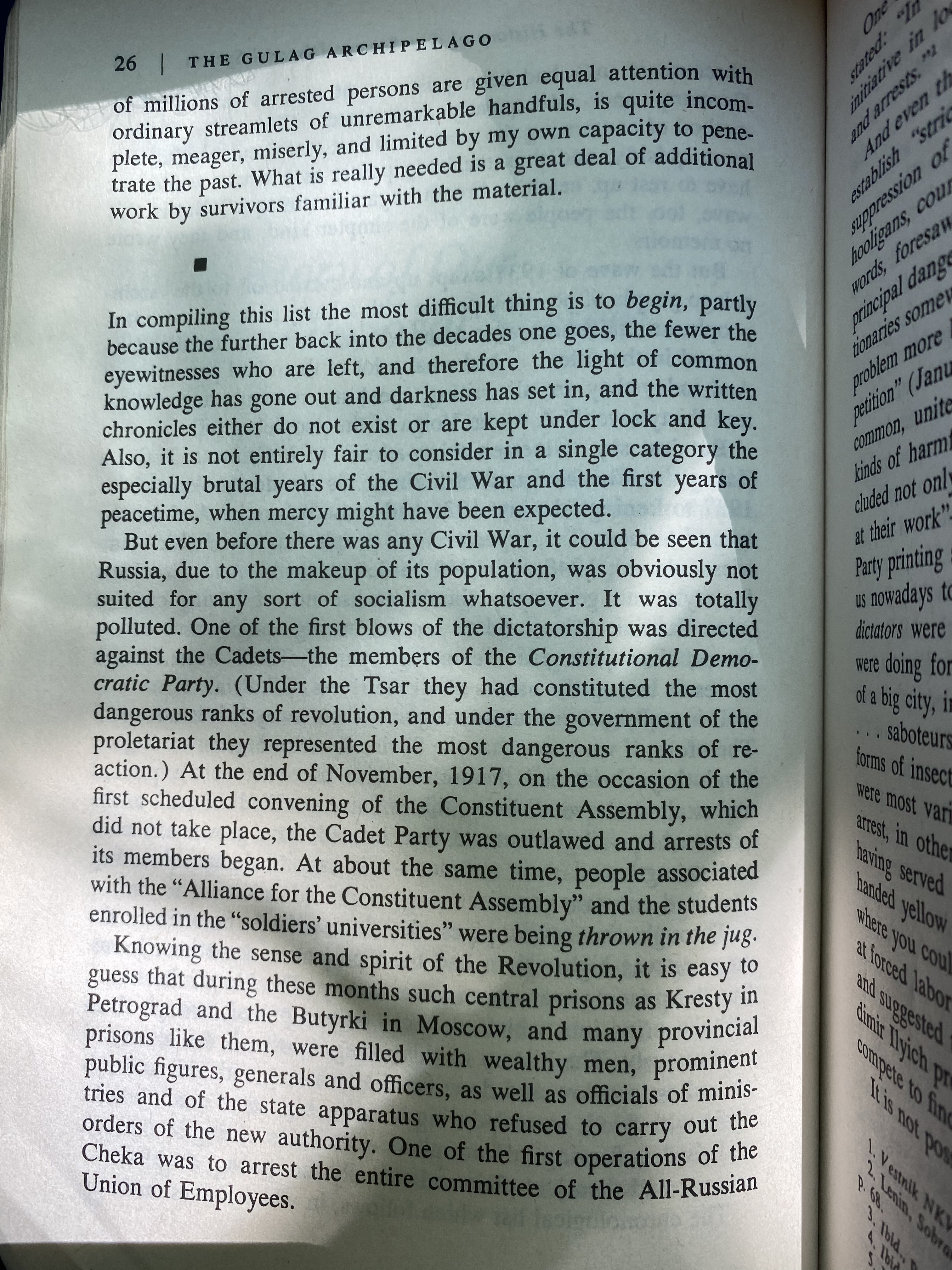
Starting to get that feeling in the first 26 pages. It’s great and have wanted to read it for a while now. But wondering what the take is here on it overall.
The line he literally wrote about the population size of Russia being unsuitable for socialism is like verbatim RW criticism used today and typically repeated when saying that it while it may work in small European counties it won’t here.
Need also to brush up on the Russian Revolution, having only read some of John Reed’s account.
As usual, Parenti has a good read on the gulag system:
In 1993, for the first time, several historians gained access to previously secret Soviet police archives and were able to establish well documented estimates of prison and labor camp populations. They found that the total population of the entire gulag as of January 1939, near the end of the Great Purges, was 2,022,976.3 At about that time, there began a purge of the purgers, including many intelligence and secret police (NKVD) officials and members of the judiciary and other investigative committees, who were suddenly held responsible for the excesses of the terror despite their protestations of fidelity to the regime.
Soviet labor camps were not death camps like those the Nazis built across Europe. There was no systematic extermination of inmates, no gas chambers or crematoria to dispose of millions of bodies. Despite harsh conditions, the great majority of gulag inmates survived and eventually returned to society when granted amnesty or when their terms were finished. In any given year, 20 to 40 percent of the inmates were released, according to archive records. Oblivious to these facts, the Moscow correspondent of the New York Times (7/31/96) continues to describe the gulag as “the largest system of death camps in modern history.”
…Should all gulag inmates be considered innocent victims of Red repression? Contrary to what we have been led to believe, those arrested for political crimes (“counterrevolutionary offenses”) numbered from 12 to 33 percent of the prison population, varying from year to year. The vast majority of inmates were charged with nonpolitical offenses: murder, assault, theft, banditry, smuggling, swindling, and other violations punishable in any society.
At the beginning of that passage, when Parenti refers to historical reviews of Soviet archives in 1993, he cites historian J. Arch Getty. Getty’s work is a good starting point for getting to the modern academic consensus on the Soviet penal system, instead of sensationalized horror stories.
When assessing conditions in the Soviet penal system in the 1930’s one should compare it to conditions in contemporary penal systems. Were inmates in gulags worse of than inmates in German, French or American prisons and prison camps at the same time.
I’m sure that if you changed a few names you could easily pass off an account of life in the US Angola prison in the 1930’s as a Gulag horror story.
gulag archipelago is a work of fiction with a clear political agenda, yes. we had to read excerpts in school. at some point i got halfway through maybe, but its just too damn long. anyway, it was a pretty effective anti-soviet propaganda piece, lots of people even in russia believe it as fact still. no actual historians worth their salt take it seriously though
The author’s own ex-wife who helped him write it said it was a complete work of fiction. IIRC it’s entirely just accounts from random people that Solzhenitsyn takes at face value as well as stuff he pulls out of his ass. He strikes me as a kindred spirit of Adrian Zenz, they share a similar approach.
I believe he was put in prison because he wrote a letter critical of Stalin and sympathetic to the Nazis (dude just loved fascists, especially Franco), though there is reasonable speculation that he did that with full knowledge of the consequences so he could avoid serving in the Red Army in WW2.