On the flip side, a lot of other languages have retained structures which require a detailed knowing of grammar in part because they haven’t needed to be learned by amateurs.
I speak several languages, most of which are Romance languages (such as French and Italian) which have a specific word order which pretty close to english (though adjective come after nouns rather than before, plus there are some additional verbal times though those are uncommon to use).
Amongst those I also speak Dutch and German, which have quite a different word order (though, curiously, Dutch from Belgium has a similar word order to French) and I constantly fuck it up (especially in German, which is the one of the two I speak worse) and the natives always understand me.
In my experience learning two of those languages just by living there (and with people that are learning my own native language), it’s using the wrong words that confuses people, then using the wrong accent (mainly by putting the emphasis in the wrong syllable) and only as a far third is word order and even that only in specific cases such expressions (where it’s the whole expression as is that has a meaning, rather the meaning being a composition of the meaning of the individual words in it).
In my experience there really is no special quality of the English language that makes it easier to understand when people use a wrong word order.
True, though I would personally count that as a bad thing. Purity of language, to me is irrelevant. That opinion may be coloured by the fact that I’m a native English speaker, and there hasn’t been anything resembling purity in this language for thousands of years. To me, the point of language is open communication. Any impediment to that is a negative.
There weren’t many amateurs desiring to learn English back in eleventh—fifteenth centuries, when it was losing the remaining complexity in the grammar.
There were a lot of native French speakers in England at that time, so a bunch of normalizing like what happened a couple hundred years earlier with the Norse meeting Anglo-Saxons
Idk about Vikings, but to my knowledge Normans didn’t give a crap about English, speaking their language among the ruling class, and all documents were in French. This is evidenced by the fact that there’s little written record of how English developed at the time. On the other hand, French was perceived as prestigious, since people had to deal with the ruling class and bureaucracy in French, thus many ‘high-society’ words were borrowed into English — hence typically when talking about everyday matters, the words are mostly of Germanic or Norse origin, and grandiose abstract ideas or upper-class life are French/Latin.
It’s not like trade with Normans started only after the conquest, after all.
Yes, and because of that there was a lot of interaction and blending, right up to the point where trials were required to be performed in English in the mid-14th century, then in the 15th everything was switched to English.
The Peterborough Chronicle perfectly demonstrates the transition from Old English to Middle. It was written over about a hundred years (11th to 12th Century) and gradually starts incorporating French vocabulary and dropping old Germanic grammar.
Ah. I misremembered about the Peterborough Chronicle being the one switching to French because of a new French abbot.
Still not seeing how much of it was informed by the Frenchmen wanting to learn English, though. Englishmen for sure did borrow French vocabulary, not sure about the other way around. I’m yet to learn about switching the trials to English, as I’m right at the point of Norman conquest in the ‘History of English Language’ podcast. =)
Seems so far that said history was in large part dictated by political happenings.
Well, the aristocracy didn’t just learn English overnight. The transition of official use over about 200 years shows them becoming more and more accepting and comfortable with it.
Whereas English has adopted so many idioms from other languages with different grammar that we’re entirely comfortable with the exotic phrasing, or if it’s ambiguous we make puns and/or poetry from it.

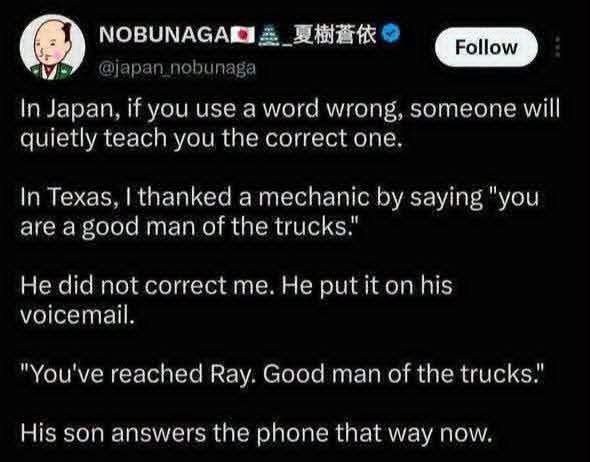
On the flip side, a lot of other languages have retained structures which require a detailed knowing of grammar in part because they haven’t needed to be learned by amateurs.
I speak several languages, most of which are Romance languages (such as French and Italian) which have a specific word order which pretty close to english (though adjective come after nouns rather than before, plus there are some additional verbal times though those are uncommon to use).
Amongst those I also speak Dutch and German, which have quite a different word order (though, curiously, Dutch from Belgium has a similar word order to French) and I constantly fuck it up (especially in German, which is the one of the two I speak worse) and the natives always understand me.
In my experience learning two of those languages just by living there (and with people that are learning my own native language), it’s using the wrong words that confuses people, then using the wrong accent (mainly by putting the emphasis in the wrong syllable) and only as a far third is word order and even that only in specific cases such expressions (where it’s the whole expression as is that has a meaning, rather the meaning being a composition of the meaning of the individual words in it).
In my experience there really is no special quality of the English language that makes it easier to understand when people use a wrong word order.
Mate we’re all amateurs here. Unless you are being paid to learn languages
I’m not paid specifically to speak English, but I feel like meetings would go a lot longer without it
True, though I would personally count that as a bad thing. Purity of language, to me is irrelevant. That opinion may be coloured by the fact that I’m a native English speaker, and there hasn’t been anything resembling purity in this language for thousands of years. To me, the point of language is open communication. Any impediment to that is a negative.
I lik your way of doyng byzness
They’re talking about English, not Welsh
I just fixed your dumb spelling >:(
Here he is, fuckin get em
There weren’t many amateurs desiring to learn English back in eleventh—fifteenth centuries, when it was losing the remaining complexity in the grammar.
There were a lot of native French speakers in England at that time, so a bunch of normalizing like what happened a couple hundred years earlier with the Norse meeting Anglo-Saxons
Idk about Vikings, but to my knowledge Normans didn’t give a crap about English, speaking their language among the ruling class, and all documents were in French. This is evidenced by the fact that there’s little written record of how English developed at the time. On the other hand, French was perceived as prestigious, since people had to deal with the ruling class and bureaucracy in French, thus many ‘high-society’ words were borrowed into English — hence typically when talking about everyday matters, the words are mostly of Germanic or Norse origin, and grandiose abstract ideas or upper-class life are French/Latin.
It’s not like trade with Normans started only after the conquest, after all.
Yes, and because of that there was a lot of interaction and blending, right up to the point where trials were required to be performed in English in the mid-14th century, then in the 15th everything was switched to English. The Peterborough Chronicle perfectly demonstrates the transition from Old English to Middle. It was written over about a hundred years (11th to 12th Century) and gradually starts incorporating French vocabulary and dropping old Germanic grammar.
Ah. I misremembered about the Peterborough Chronicle being the one switching to French because of a new French abbot.
Still not seeing how much of it was informed by the Frenchmen wanting to learn English, though. Englishmen for sure did borrow French vocabulary, not sure about the other way around. I’m yet to learn about switching the trials to English, as I’m right at the point of Norman conquest in the ‘History of English Language’ podcast. =)
Seems so far that said history was in large part dictated by political happenings.
Well, the aristocracy didn’t just learn English overnight. The transition of official use over about 200 years shows them becoming more and more accepting and comfortable with it.
Whereas English has adopted so many idioms from other languages with different grammar that we’re entirely comfortable with the exotic phrasing, or if it’s ambiguous we make puns and/or poetry from it.