
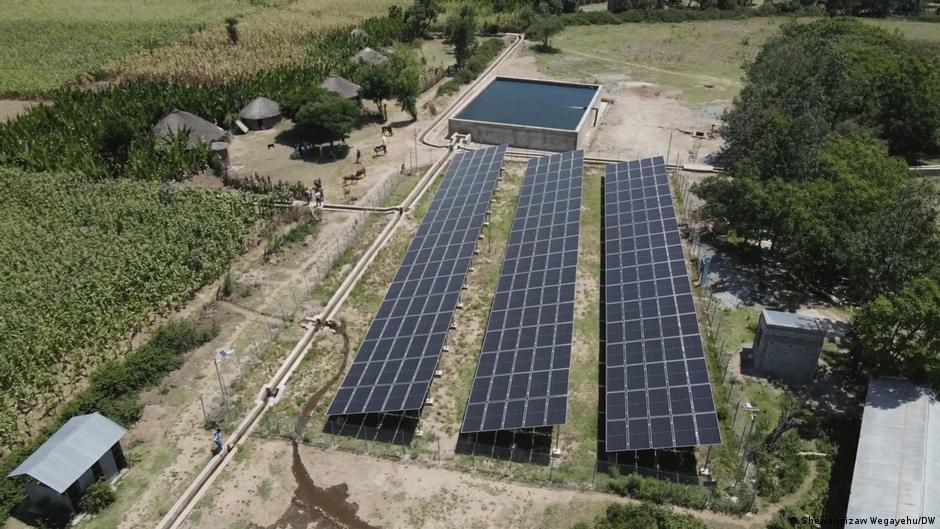
I look forward to an age where there’s so much distributed solar power that it’s not about building up infrastructure, but making cool patterns you can see from space.
We’ve come full circle from drawing nazca lines 2000 years ago to what I hope is dick butt from space.
Perfect use case.
The west is falling behind thanks to Trump and Carney.
I don’t really think this comment is responsive to the article. Solar is getting built out everywhere (including in the US), and the baseline high energy consumption of the west obscures the smaller percentage based change while still representing a huge absolute change in energy source mix.
Carney is actively fighting imported solar panels.
So not the West, just North America.
The rest of the West it’s been established for a while and/or surging. My house is solar powered with batteries. The grid is 100% powered by two solar farms, two wind farms, and one hydroplant. It’s weird seeing a house that doesn’t have solar panels covering its roof.
And Carney is being portrayed as sensible because he’s “not as bad” as Trump. Radical flanking in effect.
Especially with his cuts to Canadian Food Inspection Agency
Some of these agencies had a ridiculous number of people doing sweet fuck all. Over 10,000 worked at Health Canada, one of the bloated and inefficient agencies. CFIA had 6,400 people.
I know you work in government but the model of poor productivity is not sustainable in a country with this GDP.
Restructure and invesetment is almosy always more sensible then cuts. Cuts are for when things are so bad that that are intended to lower the quality and growth of services.
Conservitives keep trying to run gov agemcies like bloated investor driven companies and it really shows
lol no, USA only. The EU is happily rebuilding the bridges to Europe, that the USA have burned.
This is one of those things that no one realizes cause no one draws too much attention to it, but the US hasn’t been slacking on renewables in general - https://en.wikipedia.org/wiki/Solar_power_in_the_United_States - https://earthenergylog.com/articles/solar-power-statistics-us-2026
The thing is, developing countries will always see a bigger impact from newer technology because they are developing and so are building up base capacity. In the US we already have a lot of base load that already exists, so new power is to either increase overall load or to replace. Both of those things typically happen slower than new build out.
Also solar is more decentralized by it’s nature so you don’t need to deploy all the infrastructure normally expected. A village doesn’t need to be connected to a larger grid to receive power during the daytime. Heck, a lot of individual homes can manage if the owners can afford panels and batteries.
It still needs to be connected to the grid to receive power at night unless you think every village can afford battery storage
Remote village doesn’t make baskets, bread, in the night.
Batteries are super cheap now. Even in US, $100/kwh at 2400kwh+ bms/connections pack range. Means you can oversize it for half average charge/discharge utilization and pay just 2c/kwh. solar installation on homes in China is 70c/watt, and with no tariffs and even cheaper local labour, that can offset shipping costs. So 6kw solar and 20kwh battery costs $6200. That’s a $17.22 monthly electric bill that is inflation proof.
LiPh batteries are down to $80 kwhr.
How on earth do you go from saying it’s $100 per kwh to paying $0.02 per kwh? I don’t think anyone would accept a 500 year time to pay off their initial investment.
the battery charges/discharges every day. If it did so in full, for 10000 cycles, that would be 1c/kwh lifetime electricity premium from battery. In terms of time value of money consideration, it is a fully tax free savings/return, and inflation proof. I gave China as an example. They have very low “risk free” interest rates, but it is easiest to adjust long term government bonds to tax free return as an approximation of inflation savings, to every country.
Still need the grid as in winter months output is low. So 6 kW solar and 20 kWh battery is rather unbalanced.
Doubling the budget is doubly the monthly electric bill. An EV getting a free monthly fuel bill 10 months of the year, is also a winter resilience device to charge the home with a trip to commercial charger. Majority of low income countries, topic, are concentrated around equator and lower seasonal variation. Rainy season in summer often means more winter than summer production.
Whoops. I got it wrong, sorry. If we follow Victron’s recommendations (4.8 kWh backup for 1.5 kWp generation) than for 6 kWp the LiIon backup (AC-coupled) would be pretty exactly 20 kWh. So your numbers are perfectly balanced.
The problem with just scaling up is that in winter months I can easily see 1/20th to 1/40th of PV nameplate during daytime, and such conditions can persist for more than a month. So without the grid as a backup the only option is diesel generation backup, or going entirely without any major power drain.
For low-consumer countries in the tropics the equation is much easier, since they’re consuming less than Westerners in general.
Dont blame others for american issues. Regressive losers. Carney beat the trump fan to create stronger ties.
*The West is falling behind thanks to fascists and neoliberals, Trump being an example of the former and Carney the latter. You’re letting off the Merzs and Macrons of the world too lightly.
usa using solar to power data centers not net zero