Does it get too dry? Go stale?
Is there something that makes dried pasta unable to rehydrate?
Salt has expiration dates.
Salt never expires.
At least in Europe (but I suppose it’s the same in other places), what you have in packaging is either expiry date or best before date.
There is a fundamental difference between the two that everyone should know to understand how those dates work:
On expiry date, it means that after said date, there is microbiological contamination risk of the good. So you shouldn’t eat/use it after the date. It applies to fresh goods, cosmetics and others.
On best before date, it means that the product, after said date will be most probably safe to eat but it’s organoleptic properties might be altered (e.g. change in colour, funny taste…). After a best before date, you should check for the item to see if visually there’s something wrong on it (especially if packaging is open), but if it’s been kept in it’s packaging unopened, it’s almost certainly safe to eat. Pasta and other dried foods generally fall into this category and, if you look at the packaging, you’ll see that unless is fresh pasta, it includes a best before not an expiry date.
All of the answers here are missing something: pasta has a very small amount of fat in it. Eventually that fat goes rancid.
You can significantly extend shelf life of things like pasta and rice by storing them in inert gases but that’s not done generally.
In dry stuff it’s generally the fat going rancid.
Though I’ve used 5 year old pasta and it was fine. The fat may have been rancid, but I suspect between boiling and immersion in sauce you just wouldn’t taste it.
(Also, rancid fat isn’t necessarily harmful).
How much fat does pasta typically contain?
This is from the package of spaghetti on my counter.

That’s not made from durum wheat and water, though, which most dry pasta is.
Edit: checked a packet of wheat pasta and it’s got 1% fat, so pretty close.
Yeah most fish oil supplement capsules have gone rancid by the time they make it to the consumer iirc
Mmmm…rancid fish vitamins.
I always assume that expiration dates on non perishable good is more to do with the integrity of the packaging then the food itself.
Also legal limits, different categories of food have a max best before date.
This is funny when it applies to stuff like rock salt.
Billions of years in a mountain but the packaging says it’ll go bad in a few months.
also legal liability, if someone dies eating your spaghetti, you have to cover yourself
New metal band name: Death by Pasta
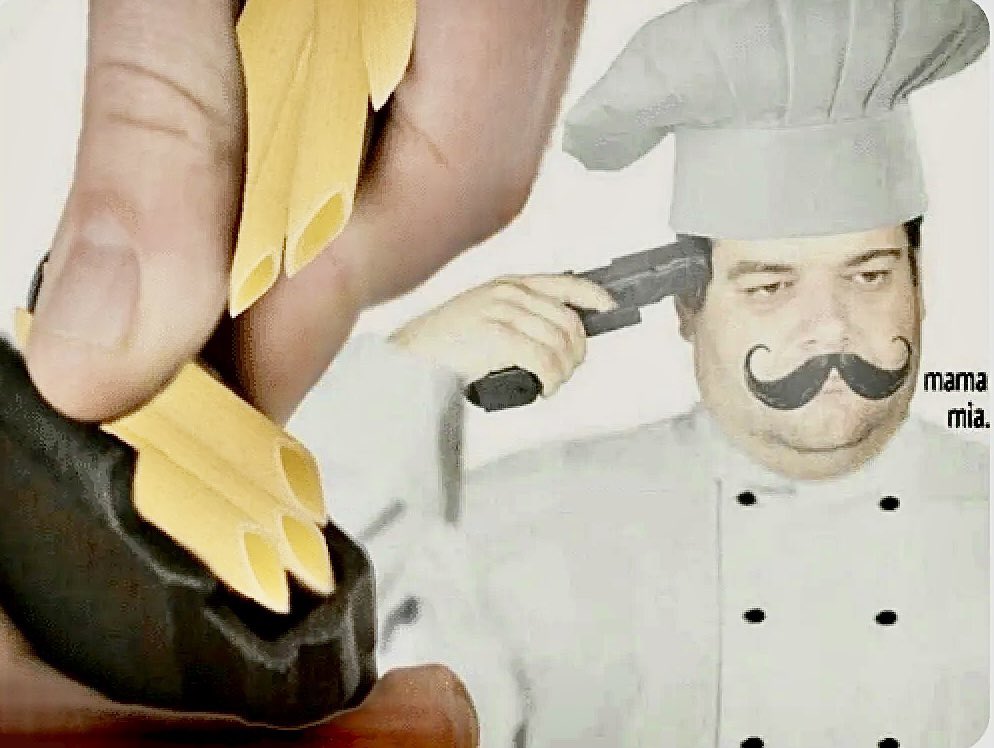
I think he is actually a French chef. Because it looks to me like he has lost the huile d’olive.
“Pasta la vista”
Brilliant!
Shrooms in the Sauce is their best album imo
Totally! But I’ve also always had a soft spot for Vulgar Display of Pesto
Marinara Massacre
Gabagool genocide.
you have to cover yourself
Like… in pasta?
Unless it’s vacuum sealed it will absorb water from the air and eventually go kind of manky. I don’t know how it is in all parts of the world, but most pasta here other than the exceptionally fancy stuff is just packaged loose in cardboard boxes that are in no way airtight.
If you stuck your spaghetti in one of those vacuum pumped storage containers to get all or most of the air out of it, it’ll probably last until the heat death of the universe regardless of what the packaging said on it.
Shelf-stable food is almost permanently good to eat. The dates mean very little to nothing.
-
Dried food can go bad if it gets wet, regardless of the date.
-
Canned food can go bad if the can is pierced, regardless of the date.
-
Crackers/chips will slowly go stale, date here is more of a freshness thing than a safety thing.
Ask me about the food poisoning my whole family got from a store bought shelf stable pie crust!! We made the pie within a couple weeks of buying the crust, but determine after the fact that it expired a year prior! 🤮
Despite the memes, apparently, Twinkies go stale pretty soon after they’re made.
that is a decidedly NOT fun fact :(
I’ve had crackers where the fat has gone rancid. Not great, but edible, especially with something to mask it - dip, peanut butter, cheese, etc
was it out of an MRE or just a back of the cupboard find?
-
I’ve got boxes of spaghetti that are at least six years old (I know I had them on hand during COVID…) which I’ve cooked up successfully as recently as last week.
YMMV with other types (particularly if it’s got any meaningful amount of oil/fat in it) but for spaghetti at least, I haven’t yet found an upper bound on usability.
Expiration dates are mostly bullshit, that said, I have seen very old pasta get a bloom on them and while it was perfectly edible, the texture was marred slightly.
Expiration dates on shelf stable foods can be ignored.
There’s a best before date, use by date, and, expiry date. Dry pasta will have a best before. Companies have this so that they can guarantee that if storage conditions are ideal, the pasta will look, taste, and cook the same as if it was fresh out of the packet. Past this date, it might get brittle, but it wouldn’t affect the food safety of the product. edit: Past the best before means that it may not have the same qualities as when before it’s best before date, but it’s likely still edible, provided the food isn’t stored in non ideal conditions (very wet or humid, stored in the heat/sun, etc.). After the date, you make the call. I probably wouldn’t eat certain foods after a certain date, though.
Extra info for those who are interested:
Best before will be things like rehydrated pasta, your meats, dairy, perishables… Though admittedly, I have eaten yogurt and hummus 4 months past the date. I lived by myself at the time and they lived in the back of the fridge.
Expiry would be things like baby formula, medication, anything that has a higher risk to health, whether it means it’s for a high risk population, or if it’s got an important role.
Edit: I’d like to add the bolded above, but also… Well, I forgot after adding the bolded stuff, so I’ll come back if I remember.
In my experience the pasta breaks apart more the older it gets during the cooking process. The end result of a particularly old box of rotini looks more like the fragments at the bottom of a bag of tortilla chips that are too small to dip with.
My personal cutoff is about 1.5-2 years after expiration
Never had an issue with taste though
In Germany there is a difference between Mindesthaltbarkeitsdatum [the food company guarantees the expected quality up to this date] so basically „best before“, and Verbrauchsdatum [If you eat this product after said date, there’s a rising probability of you getting sick] which would be the expiration date.
On some products they ask you to look, smell and taste, because it’s probably still good after the Mindesthaltbarkeitsdatum.
Britain has the Best Before date for stable foods, Use By for foods where harm could be caused, and a newer scheme to leave dates off fruit and vegetables entirely, to reduce waste.
A lot of this will be EU standard
I remember reading that at least in some jurisdictions, food producers are legally required to store samples of the food batches they’ve produced that haven’t expired yet, or something like that… so that implies they need to put something on there.
It can go bad, but it probably wouldn’t make you sick. Fats can go rancid through oxidation. It wouldn’t taste great. Proteins can decay, impacting the structure and flavor. It would probably just break apart when you tried to rehydrate it.
If you were storing it properly - no moisture and an air-tight container - it’d probably take way longer than the best before date.